//Go to Cart Button //

Howard Booth: 3 Ways to Stay Fit at 72

booth1.jpg

Accomplishments come in an abundance for 72 year old Howard Booth, who has registered for the fourth time to compete in the Meijer State Games of Michigan Summer Games. Howard’s competitive nature and commitment to physical fitness has led him to two world pole vault championships along with over 25 national championship gold medals throughout years of competing in track & field.

HB  Close up  USATF Nationals 3-4-'16  copy.jpg

Howard grew up in Mio, Michigan where he loved the outdoors and “mixing a love of nature with sports.” This love grew as Howard was a four sport athlete starting in junior high where he participated in track along with football, basketball, and baseball.

Howard’s accomplishments started at an early age as he set school and league records in pole vault, leading to a fourth place finish in the State Class D Championships. Howard also set school records in the low hurdle and high hurdle events making him a top athlete in the state of Michigan.

The commitment to being fit continued into college as Howard added gymnastics and cheerleading to his pole vaulting career. Howard now sits with his name etched among very few as he was inducted to the Eastern Michigan University Athletics Hall of Fame in 2013.

From a very young age Howard knew that his passion was for nature and sports. Howard has now retired from a 47 year teaching career as a professor of Biology at Eastern Michigan University, but that does not mean he is going to stop “practicing what I preached” to the over 18,000 students he taught in his career as a professor. Howard continues to participate in anything fitness that he can get involved in along with coaching EMU athletes in their pursuit of fitness.

HB Hurdles WMAC Close up color max copy(1).png

Howard strongly believes in the idea that the Meijer State Games of Michigan embodies, that athletes should be able to participate at any age. This belief led to Howard’s rediscovery of pole vault at the age of 61. Having competed in multiple events over the years, Howard had given up his first love of pole vault as he had gotten older. It was not until he saw 60-year-old athletes competing in the pole vault at the Michigan Senior Olympics that made him wonder if he could still do that. Howard began to believe he could pole vault again so he found a fresh proper sized maple sampling and he trimmed it into his own personal vaulting pole at the age of 61. Then using trash bags full of leaves to land on, Howard began to practice pole vault once again. After a lot of practice, Howard decided to enter the MSO men’s 60-64 age group pole vaulting competition and as he states, “I was hooked.”

Howard is now a 72-years-old master’s athlete that participates in the Meijer State Games of Michigan pole vault, long jump, 100m, and 200m competitions while enjoying being the same 125 pound athlete he was as a junior in high school.

With all that Howard has been able to accomplish in his life, he has three tips he believes everyone should keep in mind about how to maintain healthy living:

1. Find sports or activities you enjoy and pursue those enthusiastically.

You have to stay very active for your whole life according to Howard. He suggests to “work the whole body and add intensity cautiously. It has great benefits.” The key to being able to work the whole body is to find those sports and activities you enjoy most and stick with them because as he discovered through his pole vaulting story, with practice and hard work your body is more capable than you think it can be.

2. Quality NOT quantity.

HB Chatting -end of meet waiting for 2 more medals  copy.jpg

The quality of what you do is much more important than the quantity of what you do when it comes to fitness. Howard puts this rule into place especially when it comes to eating habits. He says, “Eating 90% good for you food and 10% delicious treats” is the best way to approach healthy eating habits. Howard also believes that taking the time to count your calories throughout your life is extremely beneficial. The quantity of fitness means nothing if you do not do it with quality.

3. Go through life with a positive attitude.

The most important quality to Howard is to be positive and to “involve the people around you in your activities.” Howard talked about how if it was not for his wife being his fitness partner, it would have been much more difficult to accomplish what he has in his life. People are there for you as you should be there for them, so Howard believes that you should involve those special people in your life as much as you can.

Howard has been an inspiration to so many people in his athletic journey. Howard is not done either, as he has many more goals he looks to accomplish. The next goal for Howard is to head to Perth, Australia for the Masters Athletics Outdoor World Championships. His participation in the 2016 Meijer State Games of Michigan Track & Field event is another stepping stone to achieving that goal.

Interested in Track & Field?
Visit our Summer Games Track & Field Page
 
 
###
 
The Meijer State Games of Michigan is a multi-sport, Olympic-style event(s) that welcome athletes regardless of age or ability level. The Games embody the values of participation, sportsmanship and healthy living.

Interested in our Summer Games? 
www.StateGamesofMichigan.com/summergames


Interested in our Winter Games? 
www.StateGamesofMichigan.com/wintergames


Meijer State Games Of Michigan Unveils 2018 West Michigan Corporate Challenge

Meijer State Games of Michigan today announced the creation of the West Michigan Corporate Challenge that will take place September 5-8, 2018 at various venues throughout the Greater Grand Rapids area. The West Michigan Corporate Challenge encourages West Michigan businesses to get active through friendly competition and employee camaraderie.

Diamond Dallas Page: 5 Reasons All Athletes Should Do Yoga-Based Workouts

Diamond Dallas Page is one of the most colorful and recognizable pro wrestling stars from one of the most popular eras in pro wrestling’s history. The three-time WCW World Heavyweight Champion also proved himself to be a master of branding as he invented and patented the diamond-cutter symbol that would later be used by professional athletes and music stars.
 
Remarkably, the in-ring segment of DDP’s wrestling career didn’t begin until he was 35, and in his early 40s he suffered a career threatening back injury. Fortunately, he turned to yoga and was able to return to the ring and enjoy his greatest period of success.
 
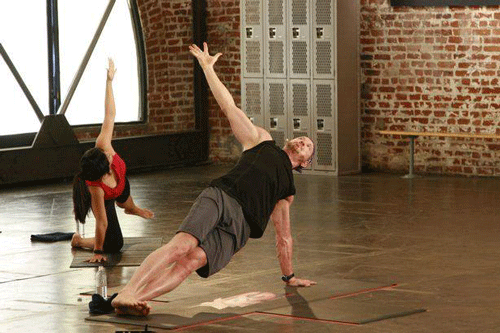
Since his retirement, Dallas has gone on to design a series of yoga-inspired workouts that are sold under the name “DDP YOGA,” and the popularity of the series has exploded. While answering our questions about his workout series, DDP offered us five reasons why all athletes should incorporate, if not DDP YOGA, at least some kind of yoga into their regular workout routines.

 1. It will increase your strength at any age

 Many parents and coaches are concerned about starting young athletes on resistance training workouts out of fear that such training will stunt an athlete’s growth. Dallas says that one of the benefits to yoga-based workouts like his is they can be modified as needed and performed by athletes in any age group. Athletes of all ages that do workouts like DDP YOGA will show obvious improvements in strength and, more importantly, no negative side effects.
 
“I’ve know kids three and four years of age doing DDP YOGA, and I’ve got an eight year old that’s really good at it,” Dallas said. “My eleven-year-old niece, Skylar, is really good at it, she competes at the highest level of jujitsu, and she hasn’t lost a tournament in I don’t know how long. She’s just so much stronger than the other girls even though she’s tiny, and if she gets you in a rear naked choke or a triangle, you’re finished. She has never been hurt, I’d be willing to bet that she never gets hurt, and what she’s doing is something that is going to make you stronger and not beat you up like other workouts will.”
 

2. You can do it anywhere

 Many athletes get frustrated and feel like they won’t be able to get a meaningful workout if they can’t get to the gym, the pool, the treadmill or the track simply because time and circumstances don’t allow it. Fortunately, yoga-based workouts like the kind available in DDP YOGA can be modified so that they can be performed no matter what your spatial limitations might be. And, since doing the exercises properly can elevate the heart rate to 140 beats per minute or more, there is an obvious cardiovascular benefit to the workouts as well.
 
“One of my old wrestling buddies, Stevie Richards, will whip out the workouts and do them right in the middle of the locker rooms at independent wrestling shows,” Dallas said. “When you’re on a plane, you feel the effects of gravity pulling on you and dehydrating you, but if I have a little room at the front of the plane, I can do a segment of my workouts with the dynamic resistance, and I’ll be getting a workout right on the plane while I’m also breaking up scar tissue. So it’s literally something you can get done no matter where you are.”
 

3. You can do it every day

One of the shortfalls of conventional weightlifting workouts is the necessary recovery period during which the muscles heal. This means that, out of necessity, hardcore weightlifters typically take days off between weight workouts before they return to train the same muscle groups again, and workouts longer than 45 minutes are almost pointless because the muscles have been pushed to the limit by that point. In the case of DDP, his yoga workouts can easily be performed to the continuing benefit of the athlete for several hours each day, every day of the week, so there are no built-in limitations on the amount of time you can spend working out.
 
“Back when I was wrestling, I would do my yoga workouts before I went out on TV. Those TV days I would do it for three hours a day. The workouts can be done seven days a week,” Dallas said. “You can’t lift weights for three hours a day, but you can do DDP YOGA for three hours a day. By the time I went out on TV, I was pumped and looking like I’d just left the weight room but I’d also warmed my tendons up, warmed my ligaments up, and even though I was in my mid 40s, I was bouncing around the ring like I was 24. And when I was wrestling, this basically was my cardio, too. It gets you crazy strong and flexible, and it replaces cardio.”
 

4. It will prevent injuries

 Most athletes stretch to some degree before or during workouts, and before or after competitions. Despite all of this stretching, athletes at every level experience career-shortening or career-ending injuries every day. According to DDP, this is because there is a fundamental distinction between stretching and yoga that often goes overlooked, but it makes all the difference in the world when it comes to injury prevention.
 
“Yoga is not just stretching,” Dallas explained. “I stretched my entire wrestling career, and then I blew my back out and I was done. Until I started stretching and strengthening my ligaments and my tendons, and not just my muscles, then it wasn’t going to be enough. That’s what a yoga program like DDP YOGA does for you. You feel like you’re lifting, but it also takes your body into a deep stretch, and that makes all the difference when it comes to injury prevention. Of the athletes that went down with injuries last weekend playing football, probably 60 percent of them wouldn’t have gotten injured if they were doing a yoga program like mine.”
 

5. It will help you recover from existing injuries

DDP4.gif

Flexibility is one of the most underrated advantages that an athlete can have. Not only does having great flexibility give you a greater range of motion than your stiff-bodied competitors, but it also increases the limits to which you can push your body without suffering a serious injury. Finally, and perhaps most significantly, adding flexibility to your body through a yoga program like DDP’s will also accelerate your recovery time once you’ve already sustained an injury.
 
“Look at Chris Jericho,” Dallas said. “He’d just had acupuncture because he’d herniated a disc in his back, and I called him and sent him the video of the disabled veteran I helped walk again (https://www.youtube.com/watch?v=qX9FSZJu448). He got back to me minutes later and told me he’d do whatever I wanted him to. He couldn’t wrestle; he couldn’t even sing. Three months later, the pain in his back was gone, and he could get back in the ring and back on stage. Indirectly, I put millions of dollars back in his pocket. When I got injured, my vertebrae in my spine were basically bone on bone. My DDP YOGA workouts lengthened my spine and built up all the muscles around it so that I could recover from the injury.”

The Meijer State Games of Michigan is a multi-sport, Olympic-style event(s) that welcome athletes regardless of age or ability level. The Games embody the values of participation, sportsmanship and healthy living.


Interested in our Summer Games? 
www.StateGamesofMichigan.com/summergames


Interested in our Winter Games? 
www.StateGamesofMichigan.com/wintergames
 

Jim Stewart: 5 Things Every Competitive Shoot Needs To Do

stewart.gif
JimStewart.gif

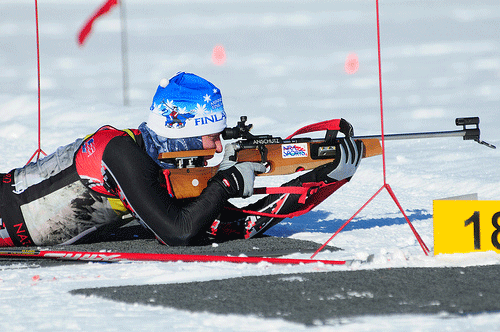
As the head coach of Michigan State’s rifle team, Jim Stewart spends a ton of time at Lansing’s Demmer Center working with the athletes from the Michigan State Shooting Sports Club to prepare them for competition.

Because shooting is a club sport at MSU, Stewart prepares his shooters for events like the NRA Intercollegiate Rifle Club Championships – an event at which the Spartans won the national championship in 2012 – as opposed to the NCAA-sanctioned championships. In keeping with the club theme, he also works with several student-athletes that are less interested in the competitive aspects of shooting, and more focused on development and social interaction.
 
Regardless as to the level of an athlete’s dedication to the sport, if shooters truly wish to get better, there are some basic things they need to do if they want do well in competitions.

 1. Don’t blame your equipment

In an sport that relies so heavily on equipment, there can be a temptation to purchase the latest and greatest rifle in the hopes that it will automatically improve the quality of a shooter’s performance. However, Jim says this method of “buying points” doesn’t always work out the way the athlete intends.
 
“Usually kids won’t put the time and effort into practicing and getting better simply because they bought some high-dollar equipment,” Jim explained. “So I’ve seen kids with expensive equipment that can’t shoot for anything, and I see kids with mediocre equipment that are really pushing the limits of the equipment because they’re so good.”
 

2. Get a coach

2_ coach.gif

If you want to get better at anything, it’s logical to find someone better than you and learn from them. In the case of shooting sports, Jim says that finding someone to coach you may be the first step toward ultimately landing a scholarship to join the team of a top college or university. 
 
“If you start working with a coach, and you show any skill at all, your name will get passed around to a lot of coaches,” Jim said. “These coaches will pass you on to a state association coach. They have coaches that will coach the kids up and take them to different shoots and competitions around the country, and from there the kids will get noticed by coaches from some of the big schools. Coaches are good about moving shooters’ careers along.”
 

3. Figure out how dedicated you are

 Like most activities, the more time someone spends practicing with a rifle, the better they get at shooting. As Jim pointed out, someone deciding between competing at a school with a club program or a varsity program can come down to how much time they are willing to dedicate to mastering their craft and improving on several levels.
 
“At Michigan State, rifle is a club sport, so we have one organized practice each week, and the kids are encouraged to come in and practice on other days as much as possible,” Jim said. “If this were a club sport, it would become more of a job; we would shoot three times a week minimum and do other strength and conditioning drills on other days. Students have educational and social lives that are competing for their attention, and they need to decide how much time they are willing to part with to get better at a sport.”
 

4. Get in shape 

 To a casual observer, marksmanship relies exclusively on the sharpness of the shooter’s eye, coupled with basic hand-eye coordination. However, over the course of a shooting competition that can last well beyond an hour, Jim says the physical stamina of a competitor can come into play, and that can result in them being off target with shots that they would otherwise make.
 
“You need to be able to stabilize your body to maintain the same position with a calm demeanor and a low heart rate for a long period of time,” Jim said. “All of these things can be worked on with strength training and conditioning.  And you don’t really see any big, out-of-shape shooters at the highest levels. So, it’s an athletic sport in a different sense; the most athletic are those that can stay the most still.”
 

5. Compete regularly 

 
Ultimately, it doesn’t matter how well someone shoots on the practice range if they can’t repeat the performance during a competition. When the pressure mounts, Jim says a lot of competitors get a bad case of nerves, and this wreaks havoc on their shooting. Unfortunately, the pressure that comes with a tournament will never go away, so shooters simply need to get used to it.
 
“Typically, the athletes that win are those that control their nerves and emotions better than anyone else,” Jim explained. “The way you overcome the pressure of the situation is simply by doing it. Eventually, you get to the point where you don’t even see or hear the crowds because you’re so comfortable in your environment. You’ll just realize you’ve done it lots of times and you can relax.”
 
Interested in Shooting?
Check out the Meijer State Games - Winter Games Shooting Information
Check out the Meijer State Games - Summer Games Shooting Information

The Meijer State Games of Michigan is a multi-sport, Olympic-style event(s) that welcome athletes regardless of age or ability level. The Games embody the values of participation, sportsmanship and healthy living.
 

Interested in our Summer Games? 
www.StateGamesofMichigan.com/summergames


Interested in our Winter Games? 
www.StateGamesofMichigan.com/wintergames


Glen Bennet: 5 Things Every Archer Needs To Do

ArcheryPromo.gif
Glen.gif

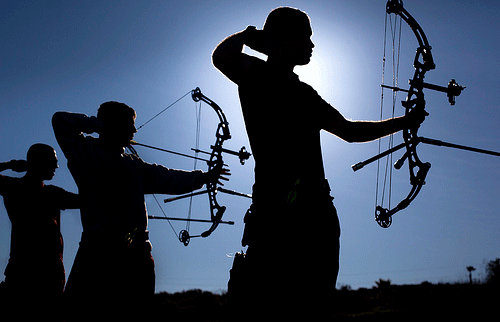
In just a short time as head coach of the Michigan State archery team, Glen Bennett has experienced a great deal of success. Under Glen’s tutelage, the team has brought several championship trophies back to the Demmer Center in Lansing, including USIAC National Championship victories for both teams and individuals.

 Glen preaches positive mental management as the driving force behind the success of the kids he coaches, and it’s tough to argue with the results. And, if the success of his team is touch to argue with, then so are the principles behind that success. Here are five of the principles Glen has used to turn recreational shooters into national champions.

 1. It’s never too late to start

Rookie archers are often intimidated when they first walk onto a range and see people that have been involved with archery for a long time hitting near the bull’s eye with every shaft. However, you should not allow your lack of experience to make you think you can never be competitive. If you’re willing to put in the work and listen to the advice of your coaches, you can become an incredible archer in a relatively short period of time.

“I had a girl that came here in 2013 with basically no experience at all, and she’s now a three-time national champion and an All-American,” Glen said. “She came in and shot as much as she could be here. She was a person that has the internal drive to want to make themselves better, and she’s been one of my best archers I’ve ever had as far as having all the right tools.”

2. Build your strength

2_-Build-Strength.gif

Archers don’t have the same sorts of strength demands placed on them as football players and hockey players that need to move opponents out of the way. At the same time, archers do need to maintain their posture, which requires an entirely different sort of muscle control and stamina. And, that sort of advantage can’t be reliably developed simply by tugging on a bowstring.

“Archers need strong core muscles and strong back muscles,” Glen explained. “We use a small training tool called Flexor that the kids use to build their core muscles. Building their muscles makes them stronger and it allows them to hold the bow steadier.“

3. Eat right to shoot straight

3_-Eat-right.gif

If you think archery is a sport where what you put in your bodies will have no influence over how well you perform, think again. While archers don’t need to worry as much about the amount of weight they’re carrying as a swimmer or a runner might, there are other ways in which a sugary snack or poor choice of refreshment may affect them.

“Nutrition is huge in archer,” Glen said. “I like kids to stay away from sugary drinks and caffeine because it makes them jittery and affects their aim. Being hungry and thirsty affect you both physically and mentally, so you need to make sure you’re hydrated.“

4. Practice with a plan

Archery isn’t like basketball or football, where practices are broken up into a series of stretches, warm-ups, drills and scrimmages. At the same time, practice sessions are not just ceaseless repetitions of firing arrows into targets for two hours. Like it is with any other sport, going into archery practice with a plan is essential for truly developing the skills that are going to make you better.

“On average, the travel team members shoot an hour to an hour and a half every day, and I like them to keep track of what they’re doing by using a shooting journal,” Glen said. “I don’t want them shooting targets all the time; I want them working on their shooting form and the shooting process. The person who shoots within a strict process will generally shoot consistent scores.”

5. Shoot to win


Even if you hope to attend a school without a NCAA-recognized archery program, there’s still an excellent chance that if you’re good enough, you’ll be offered a scholarship to compete for a school with a club team. However, no one is going to know if you’re worthy of a scholarship if you don’t get out there and show people what you’re capable of in a competitive setting.

“I can find out a lot of information on a kid from USA Archery or National Field Archery Association,” Glen said. “I can review the information and the scores, and I can see how good a kids is. Or, if I see a kid at the Demmer Center that’s doing really well at a young age, I can recommend different things to them about how to advance with their shooting, and a lot of times, those kids have already shot in juniors. So, kids wanting to get recruited should definitely start participating in competitions as early as possible.” 

Interested in Archery?

Check out the Meijer State Games - Winter Games Indoor Archery Information

Check out the Meijer State Games - Summer Games Archery Information


The Meijer State Games of Michigan is a multi-sport, Olympic-style event(s) that welcome athletes regardless of age or ability level. The Games embody the values of participation, sportsmanship and healthy living.


Interested in our Summer Games? 
www.StateGamesofMichigan.com/summergames


Interested in our Winter Games? 
www.StateGamesofMichigan.com/wintergames


Jeff Jackson: 5 Things That Will Help You Get Recruited For College Hockey

Jeff-Jackson-on-the-Notre-Dame-bench-610.gif

By the time Jeff Jackson left Michigan to become a professional hockey coach, he had already established himself as one of the most successful coaches of his generation at the college level. In ten seasons of coaching at Lake Superior State University, Jeff coached the Lakers to four NCAA Frozen Four appearances and three NCAA Men’s Ice Hockey Championships, with Jeff leading the charge toward the last two championships as the head coach.
 
Since returning to the ranks of collegiate coaches, this time at Notre Dame, Jeff has continued his winning ways by guiding the Fighting Irish to multiple CCHA Championships and NCAA Frozen Four appearances.
 
Given all of Jeff’s coaching success, it comes as no surprise that he regularly hears from young hockey players that are intent on making it onto the ice for a top college hockey program. With that in mind, Jeff shared five things with us that hockey players should do if they ever want to tie on their skates and take the ice for a Frozen Four contender.

 1. Make Your Intentions Known

Make-your-intentions-known.gif

It’s a popular misconception that college athletic programs have unlimited time and resources to spend recruiting young talent. They don’t. Programs like Notre Dame tend to concentrate on recruiting a certain talent profile within a targeted region of the country. But if you live far away from the school of your choice, that doesn’t mean you’re doomed to remain off of its recruiting radar. According to Jeff, if you want to get recruited, sometimes all you have to do is ask.
 
“It never hurts for kids, if they have an interest in a school, to reach out and send a letter or an email to express an interest,” Jeff said. “In most cases, we go out and watch kids. Some of it is word of mouth, but sometimes we hear about a kid that’s a good player who has an interest in Notre Dame. That’s how we got Riley Sheahan who is now playing for the Detroit Red Wings; we heard that he had an interest in Notre Dame, so we went out and saw him play.”
 

2. Learn To Be A Playmaker At High Speed

 Developing skills during practice is all well and good, but unless you can execute during an actual hockey game, those skills are meaningless. Not only should aspiring hockey players play in as many truly competitive games as possible, but Jeff actually suggests limiting the space you have to play in while you practice. That way, you’ll force yourself to assess situations and react quickly, and this ability will make you a more reliable playmaker for your team.
 
“The game is really about mastering time and space, both offensively and defensively,” Jeff said. “At every level you move up, there’s less time and less space to make plays. You can work on your skills, but until you can do those things with pressure in competitive situations, then you can only incrementally improve. These things are developed over time. This is why kids need to try to do things at a high pace when they’re practicing and training.”
 

3. Make Yourself Strong

Make-yourself-strong.gif

 Not only does the time and space on the ice shrink on every new level as a result of your opponent’s increased speed and skill, but it also decreases because your competition is physically larger as well. In order to compete with opponents for that decreased ice space, hockey players that truly wish to be competitive will have to get bigger and stronger in their own right. And in order to do this, lifting weights is absolutely necessary.
 
“Physical strength and explosive power are huge,” Jeff said. “When kids get to that age when they can start training their strength, they should. Some strength is natural and develops over time, but usually it can be developed with weights. Kids should focus on Olympic-type lifts like squats, cleans and deadlifts, and also things that focus on the hockey-type areas between the chest and the knees. A true 18-year-old freshman may end up competing with 24-year-old seniors, and if you’re 150 pounds trying to complete with a guy that weighs 230 pounds, that’s a challenge.”

 4. Learn To Stay In Shape Off The Ice

Let’s be honest; not everyone is blessed enough to grow up with a hockey rink in their backyard like Wayne Gretzky was. For most people, ice time comes with a financial cost, and even then, time on the ice is limited by a rink’s availability. Compounding the problem is the fact that hockey players need to have tremendous conditioning in order to get up and down the ice quickly while maintaining that speed throughout a shift. As Jeff will tell you, the best hockey players find a way to stay in shape even when ice access is limited.
 
“There are aerobic and anaerobic types of conditioning, and hockey players need to have both,” Jeff said. “A lot of conditioning can be done off the ice as long as you are willing to pay the price. There’s running, or there’s the treadmill. Hockey may be an anaerobic sport where things are done in short shifts, but you have to have an aerobic base first. It’s important to be in the top shape of your life to prepare for hockey season, but there’s maintenance done during the season and a lot of that is done off the ice. You can help yourself a lot by going at a high tempo in practice, but if you only go at three-quarters of your speed in practice, you’re not helping yourself very much.”
 

5. Get Used To Monitoring What You Eat

Get-used-to-monitoring-what-you-eat.gif

 If you’re still living at home with your parents, or even if you’re living on your own, you might be able to get away with eating whatever is put in front of you regardless as to how it may influence your body. At a top-tier NCAA program, this is not the case. So, if you’re not making disciplined dietary decisions right now, you should get used to it. Otherwise, it’s going to come as a rude awakening when the school nutritionist starts doling out the meal plans.
 
“When we have a specific player that may need to cut bodyfat, maintain their weight or even gain weight, that player is put on a specific type of diet, and that may be paired with supplements,” Jeff said. “We have things like the training table, which all the athletes attend, and we have pre-game meals and post-game meals that we all have together. So, we can track and monitor what a player eats and what they’re putting into their bodies as far as protein drinks and supplements go. It’s a big part of what we do, and we have people to monitor that for us that are professionals.”
 
Interested in Hockey?
Click here to view our Hockey information

The Meijer State Games of Michigan is a multi-sport, Olympic-style event(s) that welcome athletes regardless of age or ability level. The Games embody the values of participation, sportsmanship and healthy living.


Interested in our Summer Games? 
www.StateGamesofMichigan.com/summergames


Interested in our Winter Games? 
www.StateGamesofMichigan.com/wintergames


Melissa Hehmann: 5 Most Underrated Foods For Athletes

potatoes.jpg

When it’s time to train for competition, most athletes have a list of go-to foods they rely on to deliver the goods. And, while there’s nothing wrong with having some healthy favorites you eat all the time, you may be letting something slip through the cracks when it comes to meeting your nutritional needs.
 
Melissa Hehmann from Meijer’s Healthy Living team has compiled a list of five foods that are underrated as far as enhancing athletic performance is concerned. She explained that, while there are foods that get a lot of attention for improving performance, and for good reason, there are some nutritional powerhouses that seem to have been forgotten.
 

1. Sunflower Seeds

sunflower seeds.jpg

 When it comes to power-producing foods, athletes rarely think of nuts, and it’s even more rare for them to think of seeds. Yet, according to Melissa, sunflower seeds are one of the best natural sources of several key nutrients that can make you better at your sport of choice.
 
“Sunflower Seeds are rarely in the limelight like almonds, walnuts and flax seeds, but are an inexpensive alternative,” Melissa insisted. “They are a good source of protein and contain sports enhancing nutrients like selenium and manganese, both of which aid in fighting oxidative damage from training and promoting healthy immune function.”
 

2. Potatoes

potato.jpg

 
Athletes might be tempted to classify potatoes as an unsexy food staple that isn’t worthy of a place at the dinner table. However, potatoes have much to offer the modern athlete, and competitors that ignore the power of the potato do so at their own peril.
 
“Potatoes have been under quite a bit of criticism for not having much nutrition, which is far from the truth,” Melissa said. “Potatoes, including the sweet variety, not only provide athletes with much needed energy from carbohydrates and the electrolyte potassium, but they are also high in Vitamin B6. Vitamin B6 helps to breakdown glycogen into usable energy for the working muscles.”
 

3. Beans and Lentils

beans.jpg

 Most athletes run to chicken, beef, pork and fish when the time comes to pick a protein, but animals aren’t the only sources for quality protein. Melissa has a couple of suggestions for athletes searching for a plant-based protein that doubles as workout fuel.
 
“Beans and Lentils are packed with carbohydrates, the main source of energy for endurance athletes, and protein that aids in muscle repair,” Melissa explained. “Meat and eggs are usually the stars when discussing protein options for athletes, but beans and lentils are a cheaper protein source while also providing antioxidants and fiber that are a must for any athlete.”
 

4. Sardines

sardines.jpg


 Everybody knows what a healthy protein option fish can be, but there is more to undersea culinary choices than simply salmon, trout and cod. Next time you’re looking for a fish to eat, you might want to start with a species that’s often reduced to being used as a pizza topping.
 
“Sardines may be little fish, but they sure are mighty when it comes to nutrition,” Melissa said. “Sardines aren’t often mentioned when discussing Omega-3 Fatty Acids, but they deliver 60% of the Daily Value in a 3 ounce serving. Omega-3’s help reduce inflammation that occurs from training. Athletes abound are talking about the benefits of chocolate milk, but sardines provide just as much calcium, which aids in muscle contraction.”
 

5. Mushrooms
 

mushrooms.jpg

 
Vitamin D is known as “the sunshine vitamin” due to your body’s ability to synthesize it in your skin, but some people don’t get outside enough, or live in areas where the light from the sun doesn’t break through enough during certain times of the year. At that point, athletes who want to enjoy vitamin D’s benefits need to turn to food sources to save the day, and Melissa recommends that an overlooked source of the vitamin should make an appearance on your dinner plate.
 
“Mushrooms are a natural source of Vitamin D, which helps support strong bones and immune function,” Melissa said. “Milk and other foods fortified with Vitamin D often come to mind when thinking about food sources. Let’s not forget about a natural source of the vitamin like mushrooms.”


Melissa-Hehmann---profile-pic.gif


Melissa Hehmann, RD, CDE, ACE-CPT – Healthy Living Advisor for Meijer


The Meijer State Games of Michigan is a multi-sport, Olympic-style event(s) that welcome athletes regardless of age or ability level. The Games embody the values of participation, sportsmanship and healthy living.


Interested in our Summer Games? 
www.StateGamesofMichigan.com/summergames


Interested in our Winter Games? 
www.StateGamesofMichigan.com/wintergames


Melissa Hehmann: 5 Supplements Athletes Should Take

Supplements.gif

When it comes to athletic performance, there are a number of factors that influence an athlete’s output. However, when you get right down to it, the components of performance that are within athletes’ control include the intensity and quality of training, and the nutritional value of what they put in their bodies… and the two are proportionally related.
 
Melissa says while a well-planned diet can fuel the energy and nutrient needs of most athletes, the high-demands of training can make it difficult for some. Supplementation can be beneficial to these individuals, but Melissa also cautions that athletes should consult with their physicians and dietitians that specialize in sports nutrition before starting supplementation.

 1. Multivitamins

Multivitamins.gif

 There is more to nutrition than essential proteins, fats and carbohydrates, and if you are an athlete involved in heavy training, there may be some gaps in terms of your food’s vitamin content that need to be filled. To fill these gaps, Melissa suggests the use of a multivitamin to help your body maintain its optimal performance level.

“A basic multivitamin that is age and gender appropriate may be a good start for athletes who wish to supplement their diets,” Melissa explained. “Vitamins have been under scrutiny lately as to their effectiveness, but they were never intended to be used to replace a healthy diet. A multivitamin is an inexpensive way for an athlete to complement a nutrient-dense diet.“

 
2. Vitamin D

Vitamin-D.gif

While many vitamins can be obtained in abundance from a variety of food sources, vitamin D is acquired primarily through animal proteins, so getting enough of this fundamental nutrient can be challenging to athletes with a vegan or vegetarian lifestyle, or who live in certain regions or climates.

“Vitamin D can be obtained from foods like salmon and eggs and from exposure to the sun, but it can be challenging to get enough, especially if you live in the northern half of the United States or are an indoor athlete,” Melissa said. “Vitamin D promotes bone health and immune function, both necessary for an athlete’s training regimen. The Institute of Medicine recommends no more than 4000 IU of Vitamin D daily in the form of supplements.”

 
3. Creatine

 If you’ve been in the weight room and seen a muscle-bound bodybuilder or athlete, chances are they’re taking a protein supplement. As far as legal supplements are concerned, creatine is one of the most popular and widely used supplements among athletes because of its ability to increase strength and explosiveness.

“Creatine is a naturally-occurring compound found in muscles and an important source of fuel for intense bursts of activity, which occurs in many sports,” Melissa said. “Most meat eaters consume adequate amounts of creatine in their diet. Supplementation has been shown to increase muscle strength and reduce recovery time, but isn’t recommended for young athletes. A physician should be consulted to determine if creatine is appropriate.”  

 
4. Fish Oil

Fish-Oil.gif


 There are many reasons to consume fish, including the relative leanness of the protein contained therein. However, the most widely-publicized benefit of fish, in recent years, has been the presence of Omega 3 fatty acids within the oil of the fish. While some athletes may have an aversion to eating fish, Melissa says there are reasons to consume the oil of the fish in a supplemental form.

“Fish oil contains vital Omega-3 Fatty Acids that have been shown to reduce inflammation and boost lung function both during and after exercise,” Melissa explained. “Omega-3’s can be obtained by consuming foods like fatty fish, nuts, and seeds, but supplementation may be appropriate depending on the athlete.”

 
5. Beet Root Juice

 When it comes to beverage options and fitness, there are several drinks that compete for an athlete’s attention. These options include a variety of pre- and post-workout selections like energy drinks and protein drinks. However, Melissa says that one of the most beneficial drink options is something that most athletes are likely to overlook completely.

“Beet root juice, which is the same as Beet Juice, not only can help with an athlete’s hydration and electrolyte balance, but also provides naturally-occurring nitrates that quickly deliver oxygen to working muscles to promote increased stamina,” Melissa said. “These nitrates can also be found in celery, radishes, arugula, and parsley. “


Melissa-Hehmann---profile-pic.gif


Melissa Hehmann, RD, CDE, ACE-CPT – Healthy Living Advisor for Meijer


The Meijer State Games of Michigan is a multi-sport, Olympic-style event(s) that welcome athletes regardless of age or ability level. The Games embody the values of participation, sportsmanship and healthy living.


Interested in our Summer Games? 
www.StateGamesofMichigan.com/summergames


Interested in our Winter Games? 
www.StateGamesofMichigan.com/wintergames